


Structure and functional groups
- Molecular structure, hybridization and bonding
- Functional group identification
- Nomenclature (IUPAC naming)
- Resonance and electron-pushing basics
Organic chemistry tutoring
Organic chemistry is a different kind of course from general chemistry: instead of applying a formula, you are asked to predict how a molecule will behave based on its shape and its electrons, on reactions you have often never seen before. Tell us which course and unit is causing trouble, and the team looks for a tutor who teaches it.
Course topics
Most organic chemistry courses move through these areas in roughly this order. Naming where your course currently is tells a tutor a great deal about which skill is actually missing.
The topic students most often ask for by name: three-dimensional reasoning that no earlier chemistry course requires.
This list is illustrative rather than exhaustive. Include whether you are in Organic Chemistry I or II and your current unit so the team can confirm whether a suitable tutor is available.
Straight answers
How matching works
The Prep2Perfection team reviews your request and looks for a suitable tutor, rather than asking families to choose from an unfiltered list.
If the match is wrong
If the tutor is not the right fit, let the team know and Prep2Perfection will help arrange another suitable match.
Before you commit
New customers can start with a free demo lesson to meet the tutor and see whether the match feels suitable before continuing.
How it works
Share whether you are in Organic Chemistry I or II, the current unit — mechanisms, stereochemistry, synthesis, spectroscopy — and whether the issue is a specific topic or the exam format generally.
The team reviews the request and looks for a tutor comfortable with organic chemistry specifically, since it draws on different skills than general chemistry and a tutor experienced in one does not automatically teach the other well.
Bring a mechanism or synthesis problem you are currently stuck on. Working through a real, unfamiliar problem is the clearest way to see whether the tutor’s approach to organic chemistry’s pattern-recognition style actually helps.
Pricing
These rates apply to online monthly tutoring packages.
| Monthly package | Rate per hour |
|---|---|
| 5 hours | $39 |
| 10 hours | $36 |
| 15 hours | $33 |
| 20 hours | $30 |
One-time sessions, advanced college subjects and local or in-person tutoring may be priced differently.
Feedback
Feedback from families we have worked with. These reviews are company-wide, not specific to this course or location.
Great job
She helps me a lot!
Everything is going well thank you.
Questions
Most science courses reward memorising formulas and applying them. Organic chemistry instead asks you to predict how a molecule will behave in a reaction you may never have seen before, based on its structure and electrons — a pattern-recognition skill that most students have not had to build until this course. A tutor can work directly on that skill, using mechanisms as the practice material, rather than adding more memorisation to a problem that memorisation does not solve.
Organic Chemistry I generally covers structure, functional groups, stereochemistry and the core mechanism types (substitution and elimination). Organic Chemistry II builds on that with more complex mechanisms, multi-step synthesis and spectroscopy. Both are covered — mention which one you are in so the tutor matches the expected depth.
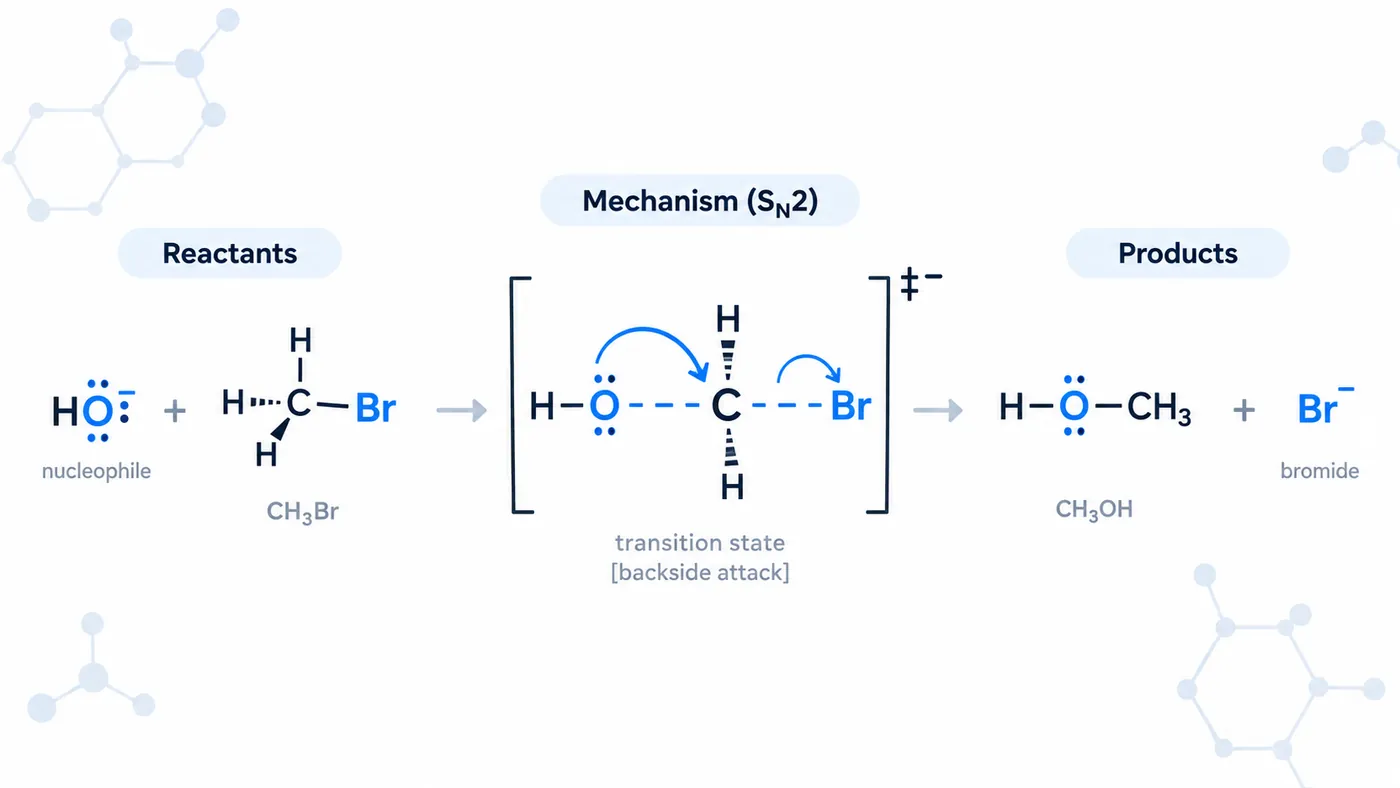
Mechanisms are exactly where tutoring tends to help the most, precisely because memorising every individual mechanism does not scale to an exam full of unfamiliar reactions. A tutor can work on the underlying electron-pushing logic that predicts a mechanism you have not seen before, rather than adding one more reaction to memorise.
Very common, and it is one of the most frequently requested organic chemistry topics for exactly that reason. It is a spatial reasoning skill rather than a chemistry knowledge gap, and it usually improves with the right practice and a tutor who can work through models and drawings with you directly.
Yes, as part of the synthesis and analysis topics most Organic Chemistry II courses cover. Interpreting a spectrum to identify a structure is a distinct skill from drawing mechanisms, and a tutor can work on it specifically if that is where your course currently is.
Yes — organic chemistry is a separate course sequence with its own way of thinking about the subject, and this page and its tutoring are specific to it. If your course is titled General Chemistry rather than Organic Chemistry, the general chemistry page is the better starting point.
No. Prep2Perfection is an independent tutoring service and does not guarantee grades, exam scores or admission outcomes, and tutoring is not affiliated with any college, university or professor. A tutor can help you understand the material and build the skills the course requires; the result depends on the work put in.
Keep exploring
High school chemistry, from stoichiometry to equilibrium.
Course-level support for undergraduate students.
How Prep2Perfection matches students with tutors, and what it costs.
Tell us your course, the unit and what is causing trouble. The team will look for a suitable tutor and you can start with a free demo lesson.
Get Matched Today