


Electricity and magnetism
- Electric charge, fields and potential
- Circuits — current, resistance and Ohm’s law
- Magnetic fields and forces
- Electromagnetic induction
Physics tutoring
Physics asks students to do two things at once — understand a concept and translate it into the right equation — and it is common to be solid on one and stuck on the other. Tell us your course and where it breaks down, and the team looks for a tutor who teaches that material.

Course topics
Physics courses follow a fairly consistent sequence, so naming where the course currently is tells a tutor a lot about what is likely causing trouble.
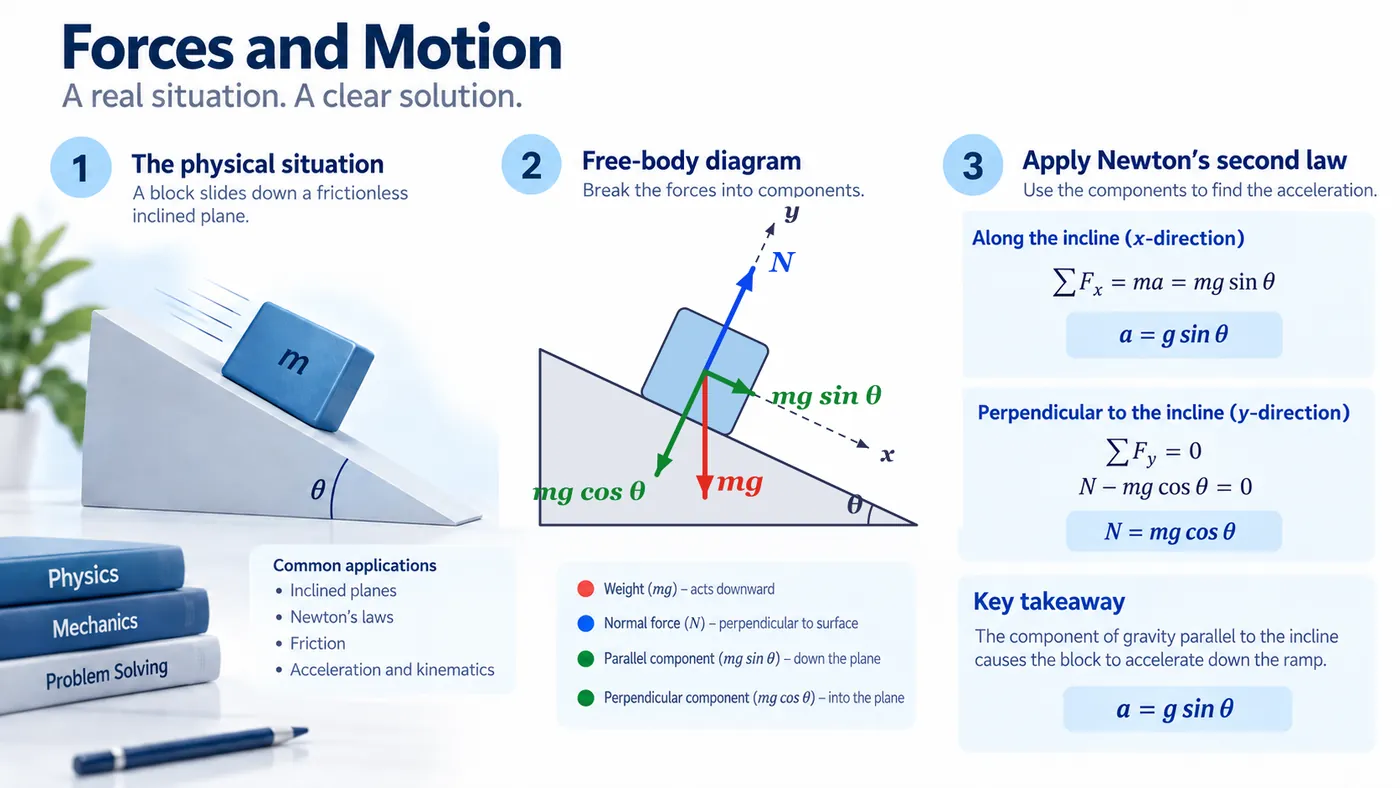
The unit most requests come in for: mechanics sets the problem-solving pattern the rest of the course repeats.
This list is illustrative rather than exhaustive, and availability for a specific specialised course such as AP Physics C depends on which tutor is available at the time of your request. Include your course name and whether it is algebra-based or calculus-based so the team can confirm what is possible.
Straight answers
How matching works
The Prep2Perfection team reviews your request and looks for a suitable tutor, rather than asking families to choose from an unfiltered list.
If the match is wrong
If the tutor is not the right fit, let the team know and Prep2Perfection will help arrange another suitable match.
Who it is for
Tutoring supports students working through difficult material as well as high-performing students who want enrichment, exam preparation or help with more advanced topics.
How it works
Share your course level, whether it is algebra-based or calculus-based, and whether the difficulty is the physics concept, the math, or translating one into the other.
The team reviews the request and looks for a tutor who teaches physics at your level and in your course format, rather than assuming any physics tutor can teach any physics course equally well.
Bring a problem from your current unit. A worked physics problem shows quickly whether the sticking point is conceptual or mathematical, which shapes how the tutor approaches the rest of the course.
Pricing
These rates apply to online monthly tutoring packages.
| Monthly package | Rate per hour |
|---|---|
| 5 hours | $39 |
| 10 hours | $36 |
| 15 hours | $33 |
| 20 hours | $30 |
One-time sessions, advanced college subjects and local or in-person tutoring may be priced differently.
Feedback
Feedback from families we have worked with. These reviews are company-wide, not specific to this course or location.
Great job
She helps me a lot!
Everything is going well thank you.
Questions
Algebra-based physics (including AP Physics 1 and 2) uses algebra and trigonometry to describe motion and forces. Calculus-based physics (including AP Physics C) uses derivatives and integrals directly, which changes how concepts like velocity and acceleration are taught and solved. Mention which one your course uses, since the two are taught differently even when the underlying physics topic is the same.
Yes — this is one of the most common physics sticking points. A tutor can separate the two problems: confirming the concept is actually understood, then working specifically on setting up and solving the equation correctly, which is often where the real gap is hiding.
You can request it, and the team will look for a tutor who teaches calculus-based physics at that level. Availability for a specialised course like AP Physics C depends on which tutor is available when the request comes in, so this is confirmed during matching rather than guaranteed in advance.
A tutor can help you understand the physics a lab is testing and work through the calculations and analysis involved, including error analysis and graphing data. They will not complete graded lab work on your behalf.
The topics overlap heavily in the first course, but college physics usually moves faster and expects more independent problem-solving between classes. Calculus-based intro college physics also assumes calculus is already comfortable, which is worth flagging in your request if it is not.
It depends on whether you are catching up on one unit, keeping pace with the current course, or preparing for a test or exam. Monthly packages are sold in blocks of hours, and the team can suggest a realistic starting point once they know the situation.
Keep exploring
Limits, derivatives, integrals and multivariable courses.
Course-level support for undergraduate students.
How Prep2Perfection matches students with tutors, and what it costs.
Tell us your course, whether it is algebra-based or calculus-based, and what you need help with. The team will look for a suitable tutor and you can start with a free demo lesson.
Get Matched Today